
[One]
THERE’S A SMALL SQUARE just off of Bourbon Street where, early last year, I got a hint in advance of what it means to miss New Orleans.
Wedged between the century-old Arnaud’s Restaurant and a dodgy gentleman’s club, Musical Legends Park takes up a prime sliver of French Quarter real estate, serving day and night as an outdoor venue for Dixieland jazz in the neighborhood where it was born.
The park is set back from the famous street, its layout behind a symmetrical iron gate invitingly pretty; it’s more of an ornate, brick-lain courtyard than an actual park. Tropical flora lines the square, which is partially covered by a steel pergola and canopy and features life-size statues of several famous New Orleans musicians, including Fats Domino, Irma Thomas, and Louis Prima: musical legends captured in weathered bronze.
The park’s focal point is a small bandstand under the pergola, with a couple dozen café tables arranged around it to accommodate the tourists and locals. They stop by to listen to jazz music performed live in one of its most traditional and best-loved forms.
As I wrote in part one, work travel at the beginning of 2024 took me for the first time to this one-of-a-kind city and its fascinating, oldest section. I stayed at the Holiday Inn on Dauphine Street, a block away from Musical Legends Park. The lodging is more commonly known by its name that goes back decades, Chateau LeMoyne, after an early 18th century founder of New Orleans.
 The LeMoyne is a comfortable hotel and atypically charming, considering its corporate affiliation. But on my first morning I knew I’d be looking for a non-Holiday Inn cup of coffee. When I asked her, the friendly concierge recommended a place around the block called Café Beignet, tucked away at the back of the music park.
The Wednesday weather was sunny and crisp as I walked out of the hotel. Expanding the map on my phone screen, I noticed a couple of landmarks I’d heard about—Jackson Square and Café du Monde—were just a few blocks away, along with that little body of water that gives New Orleans one of its nicknames, the Crescent City. So, I took a detour and headed down to a brick-lined boardwalk along a wide curve of the Mississippi River.
After a short stroll that offered a view of the Algiers neighborhood directly across the river, I stopped to listen to a guitarist playing some busker’s morning blues. I dropped a couple of bucks into his guitar case, then made my way to Café du Monde nearby. The idea of a beignet and a café au lait sounded good in my head, but the 9:15 vibe in the renowned coffee shop was a bit hectic for my taste, so it ended up more of a quick glimpse.
Meanwhile, on the sidewalk outside, a scrappy Dixieland band was 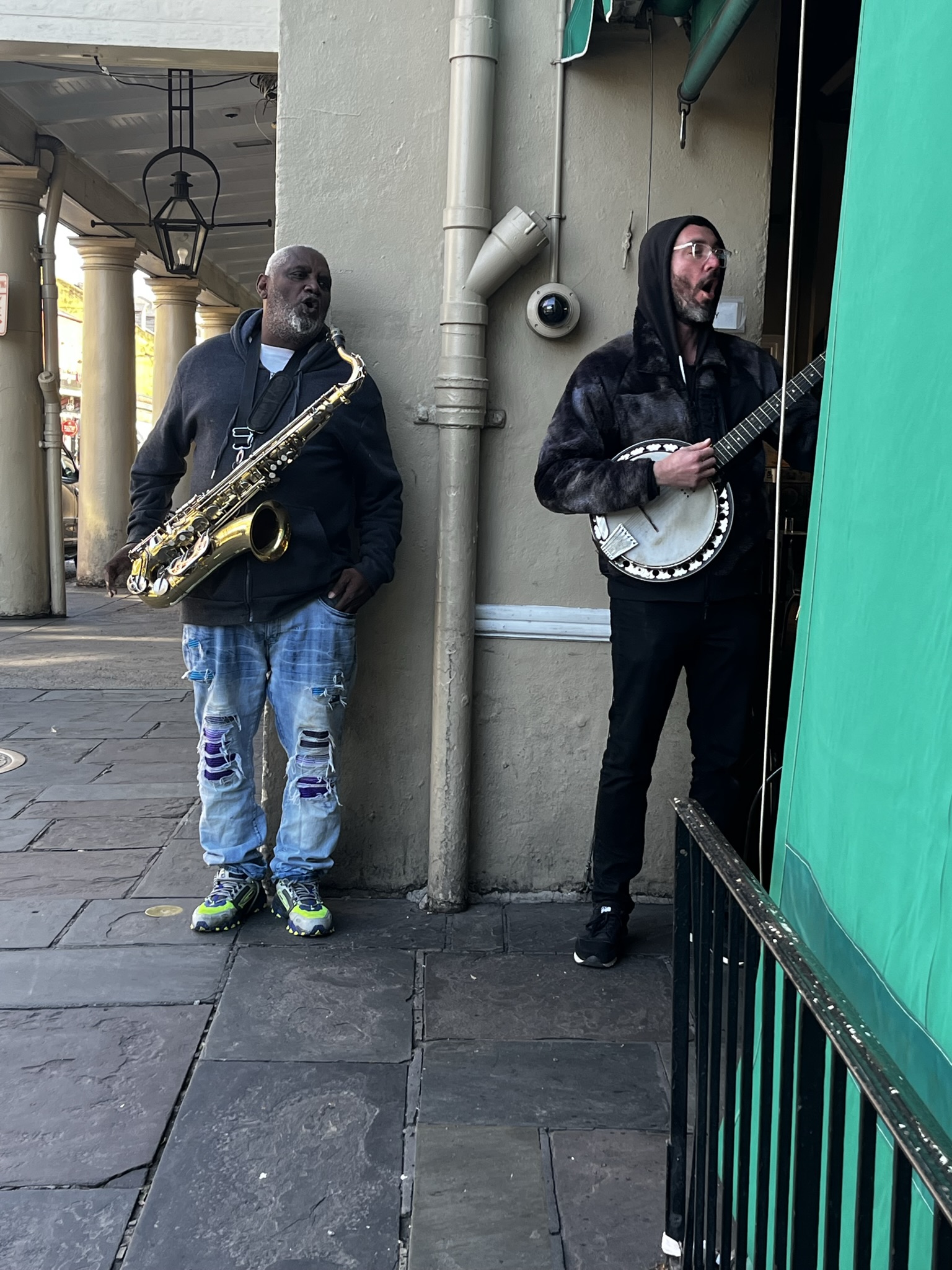 putting on a show for the crowd of passersby: a singing banjo player accompanied by a tenor saxophonist, a thumping
 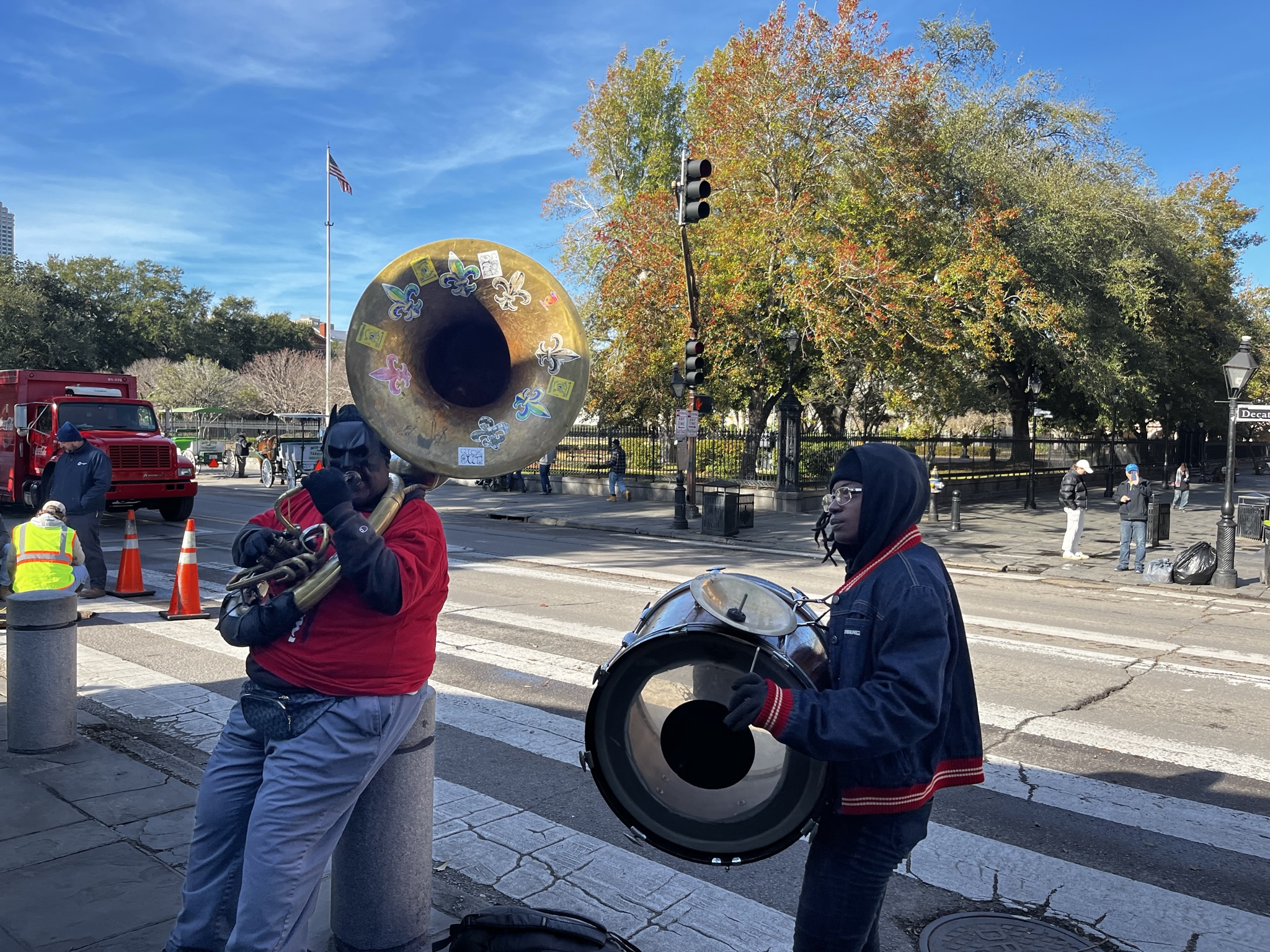 base drummer, and a guy on tuba wearing a Batman mask. Though I was surprised to be listening, already, to my second live performance on a midweek morning, I’d soon be disabused of the notion that the music—”virtually nonstop street serenading,” as Tulane University jazz historian Bruce Raeburn describes it—ever really goes quiet in New Orleans.
It was still early enough for some caffeine. I crossed Decatur Street back towards the beignet place, a route that took me straight through Jackson Square. The French Quarter’s large, historic plaza is named for America’s seventh president, Andrew Jackson, after his War of 1812 heroics in the Battle of New Orleans. According to the American Planning Association, it was designed in the image of the Place des Vosges in Paris, that city’s earliest planned square, with “iron facades surrounding the square [that] blend seamlessly into the old Spanish city hall, creating a uniquely New Orleans feel.”
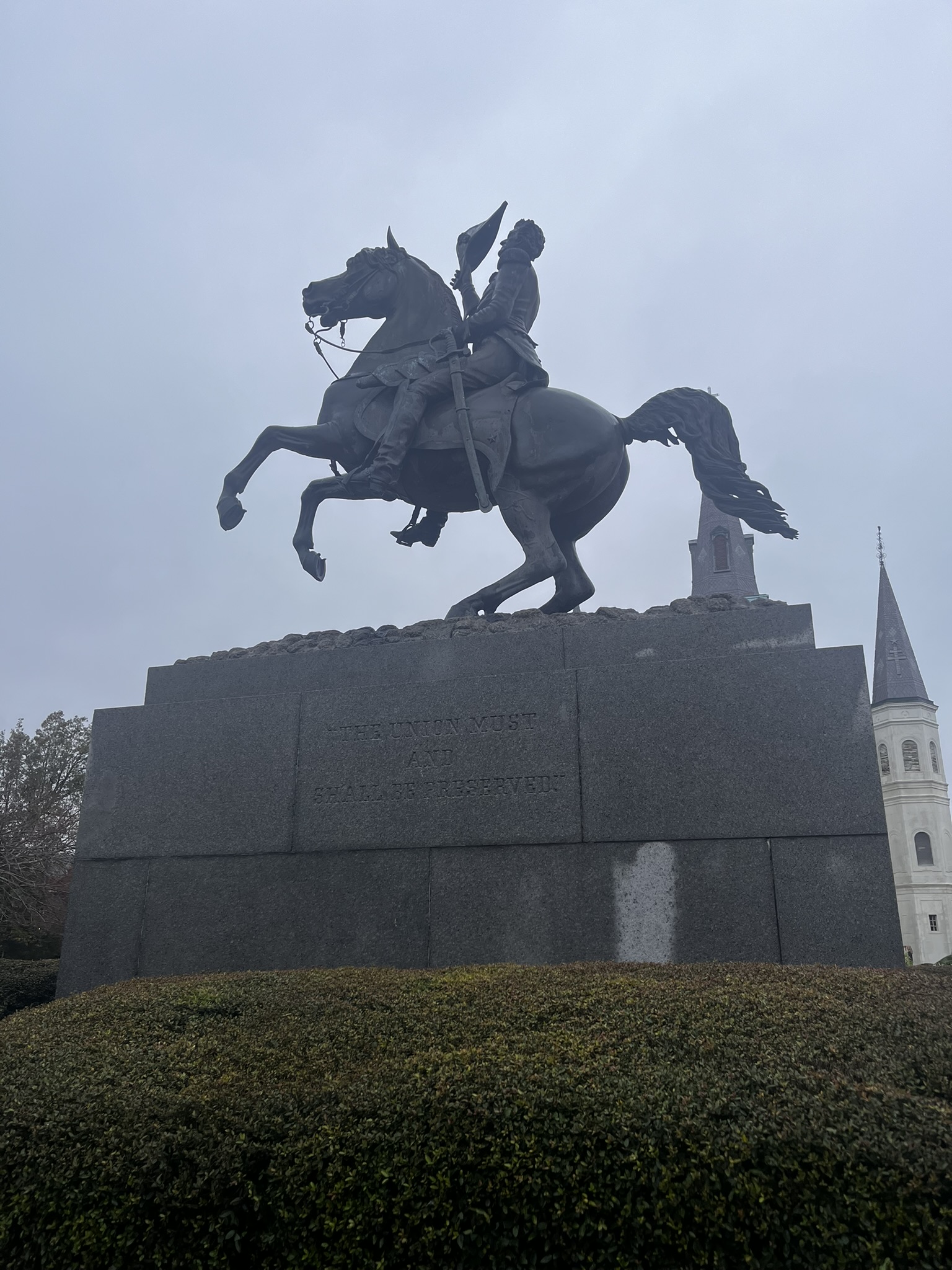 Reporting on his own New Orleans tour for an Ohio newspaper in 1877, the Greek-Irish journalist Lafcadio Hearn, whom I referenced in part one, wrote of crossing Canal Street, where he “wandered through the French Quarter into Jackson Square, and proceeded to examine the great equestrian statue of Andrew Jackson.” Nicknamed Old Hickory, Jackson was hell-bent on preserving the young nation, a historical fact noted on the monument to him in the square’s center that, like Hearn a century and a half earlier, I circled around that morning.
“Upon the eastern face of the stone,” Hearn continued, “I beheld characters deeply graven, and I discovered the characters were even these: ‘THE UNION MUST AND SHALL BE PRESERVED.’”
As a statesman and demagogue, Jackson carried an imposing reputation, in New Orleans and the rest of that day’s United States, and was no doubt accepted by Louisianans at the time for his shameful slave-owner status. They must have appreciated the bonus of his military prowess when the British army showed up in 1815, only to get thumped by his troops. Eventually, however, Old Hickory would be despised for his role as a Union-defending leader whose mantra regarding the same got etched into the statue by northern troops during the Civil War.
“It is certainly difficult to imagine what could be the object of thus chiseling the monuments of a conquered people,” Hearn wondered, “except that of inflicting petty annoyance, or perhaps, indeed, that of leaving a historical memento of the conqueror’s visitation.”
To me, that memento was like so much beautifully indelible graffiti on a big, marble middle finger.
• • • • •
Walking from Jackson Square back to the café in Musical Legends Park I could hear as I approached it—fittingly—the sound of music.
When I passed through the gateway, a Dixieland trio was just finishing a tune. The band’s leader, on trumpet, paused to chat with the crowd of twenty-odd people, both seated and standing. “A show of hands: how many of you are visiting New Orleans for the first time?” he asked over his microphone. Mine went up, along with 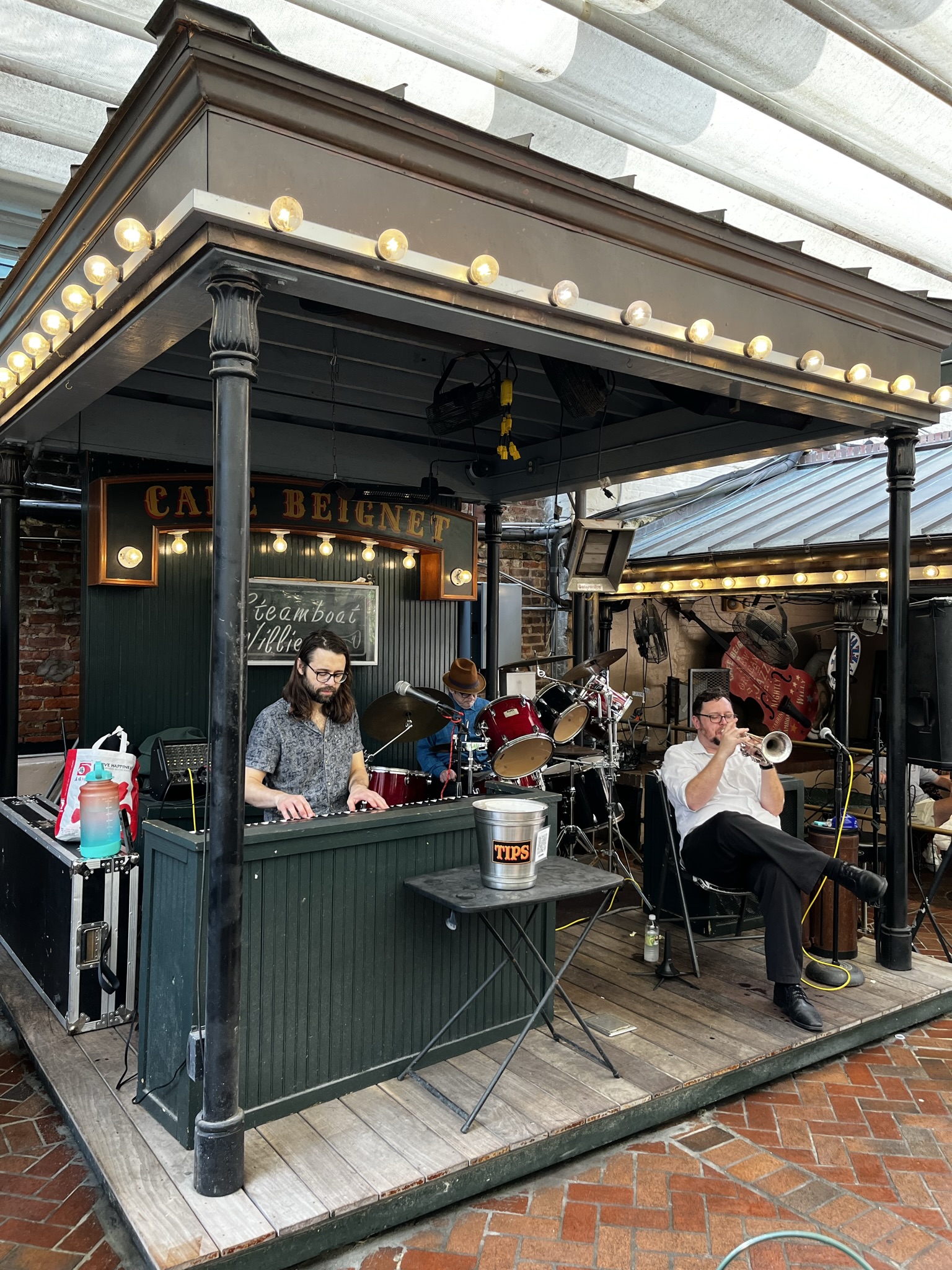 several others. “So, you’ll probably recognize this next song, but I promise you it’ll mean something different the next time you hear it.”
He started into the familiar, trumpet-colored first notes of “Do You Know What It Means to Miss New Orleans?”, the song made famous in the 1940s by another pair of legends, Billie Holiday and Louis Armstrong. It’s been performed by thousands of other musicians and occupies the top spot in the city’s soundtrack (or maybe number two after “When the Saints Go Marching In”, another song long associated with Armstrong). “The longer I stay away,” any singer of the tune laments, the more they
Miss the moss-covered vines
The tall sugar pines
Where mockingbirds used to sing
And I’d like to see the lazy Mississippi
A-hurrying into spring.
Watching this band perform conjured for me an old-timey, yet thoroughly pleasing, vibe. It put a fun exclamation point on my first morning in New Orleans. The French Quarter quickly had me in the palm of its hand, and I probably lingered a while longer than I should have in this lively, musical spot—and around Jackson Square, outside of Café du Monde, and along the lazy Mississippi. Then I had to go a-hurrying back to the hotel to get ready for my abbreviated work week, slinging wine to a bunch of affable and interesting folks.
• • • • •
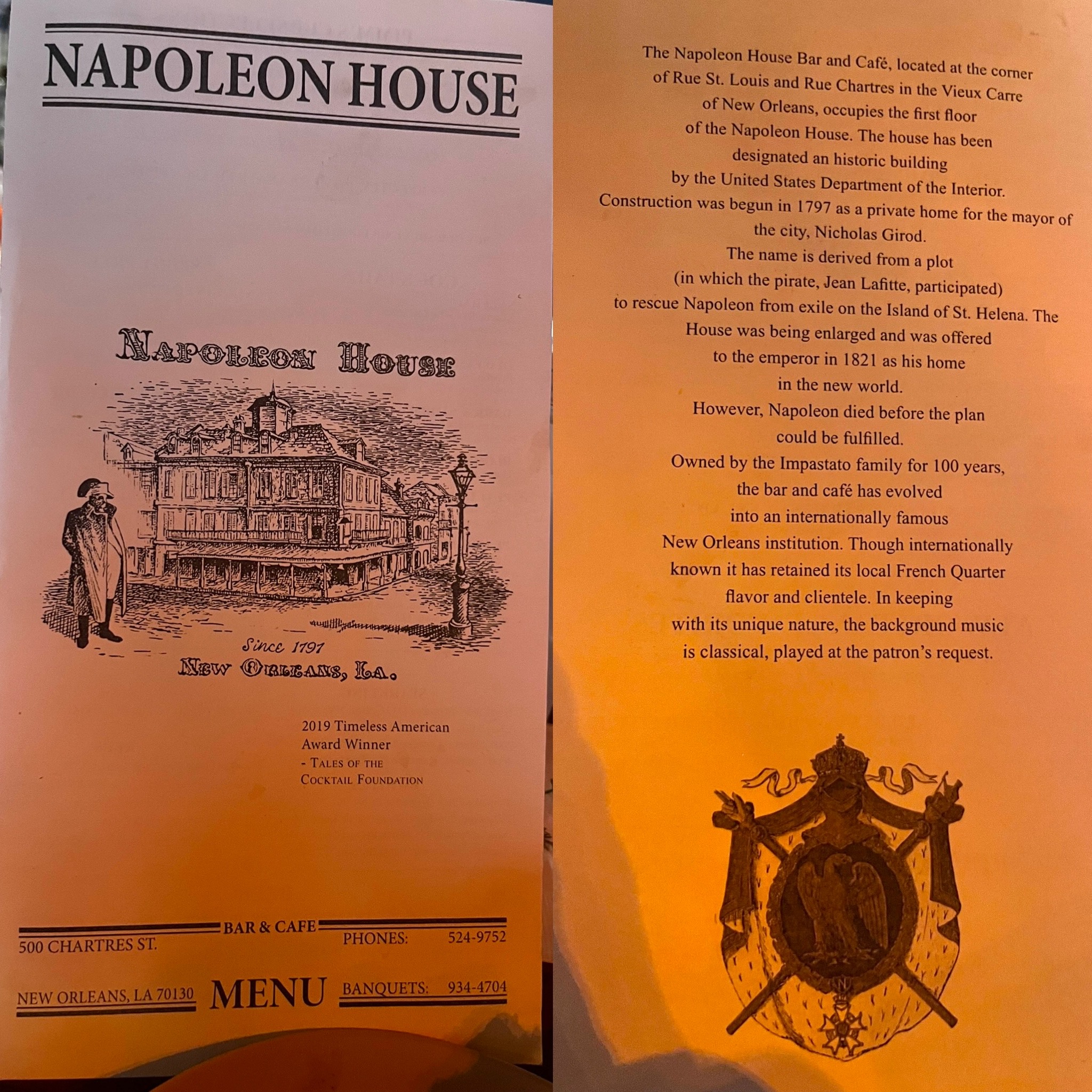 With nothing happening on Friday, it was a planned day off to explore the city on foot. As I left it in part one, the day started on the corner of St. Louis and Chartres Streets, where, at the storied Napoleon House restaurant, I discovered this thing called the go-cup. It was one of many firsts for me that week.
New Orleans’ handy drinking vessel, which figured into the 11:00 AM bar scene I described, gets a more thorough explanation in a 2020 blog post by Brent Baudean. In “New Orleans and the Go-Cup,” the history buff recounts being called “crazy” by a doorman at the Houston bar where he was camped out one afternoon. This was back in 2005, while Baudean was sheltering in the aftermath of Hurricane Katrina. He tried to walk out onto the street with a plastic cup of beer in his hand, only to get scolded.
“For many people making their first trip to New Orleans, the go-cup is a pleasantly jarring experience,” he writes. I wasn’t exactly jarred by the barman at Napoleon House offering me a Pimm’s Cup to go, but I can understand what Baudean means when he praises his city’s fellow imbibers and its “exotic foreign custom that permits them to promenade with their favorite adult beverage through the colonial vistas of the French Quarter, enjoying the sounds of street 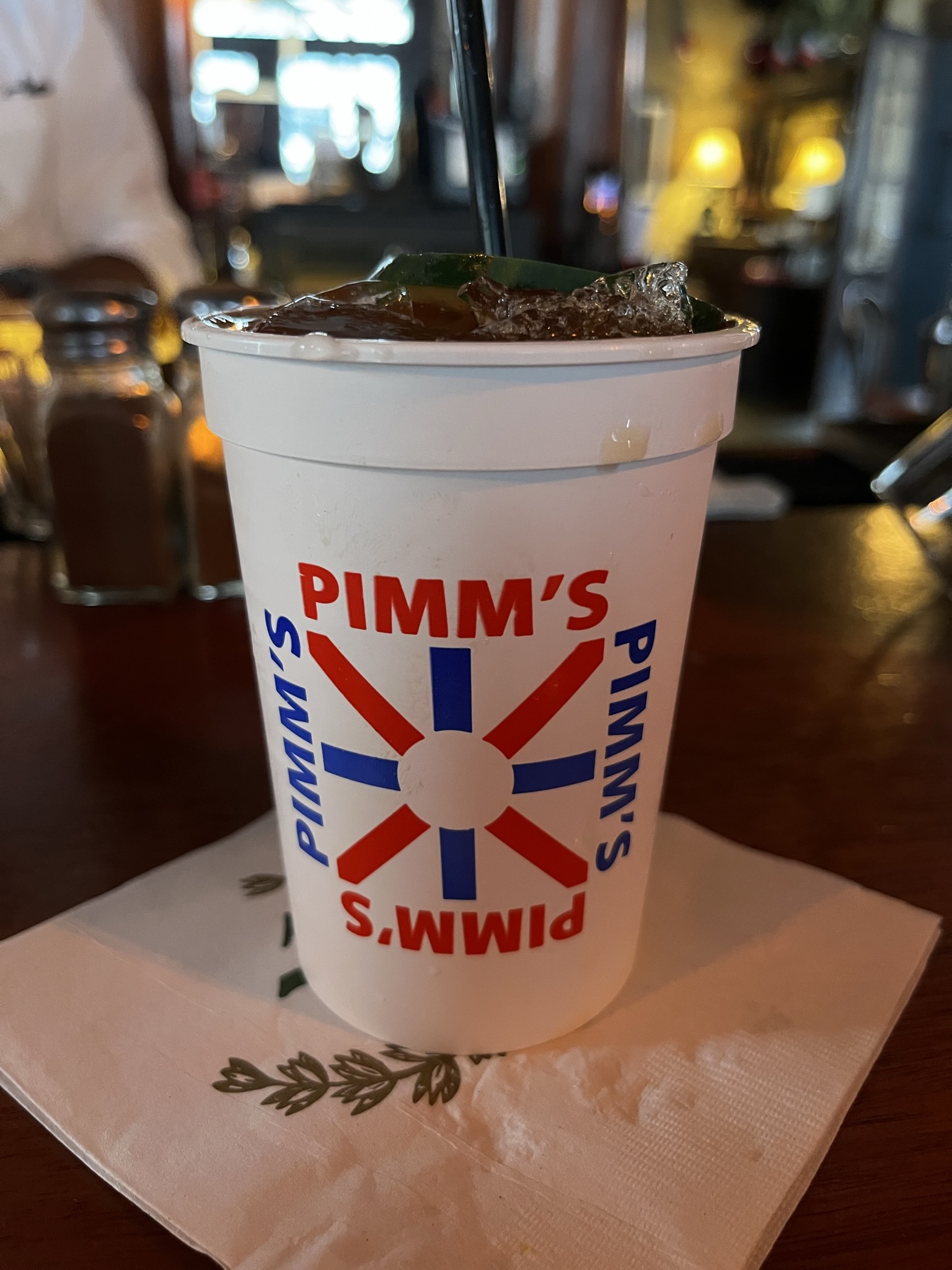 musicians, and artists selling their work in Jackson Square.” Minus my own adult beverage, I had spent the previous couple of days wandering the Quarter and experienced the same sights, sounds, and boozy revelry.
Adding that, to the locals, the go-cup is a way of life, Baudean ends his post with a defiant bit of editorial: “We think the rest of the country is weird, and you know what… we are right.”
By the time I stepped out of Napoleon House, my own go-cup in hand, I’d been in New Orleans less than 72 hours. On each successive day, the number of people in the Quarter’s streets increased at all hours, to the point of turning the atmosphere almost carnival-like, and Mardi Gras was still several weeks away. It was tempting to just stay in the neighborhood and enjoy the scene. But I had lunch and a po’ boy sandwich on my mind.
[Two]
Between the two places my old friend Marc Domres, a former and longtime New Orleans resident, had recommended for one of the city’s signature foods, Domilise’s Po-Boy & Bar was the one I decided on: the trek to get there would take me through the heart of the Garden District. And there would be a couple of surprises along the way.
I left Napoleon House and walked fifteen or so blocks down Camp Street, just past the imposing set of buildings and soaring, spaceship-like canopy that comprise the National WWII Museum. There, the road splits off at a small park to Coliseum Street, which I followed into the Lower Garden District.
In his 1998 introduction to Southern Comfort – The Garden District of New Orleans, the historian S. Frederick Starr (who a couple of years later would edit a collection of Lafcadio Hearn’s 1870s and ’80s reporting on the city) contemplates the neighborhood’s significance. “Initially part of the city of Lafayette and, after 1852, incorporated into New Orleans, the Garden District was never a distinct political entity,” he writes. “It was, rather, a metaphor that embraced notions of high economic status, political and social identity, a gracious style of life, and architectural opulence.”
Block by block, many of the homes I admired along Coliseum and on the cross-streets I detoured through were stately or otherwise impressive—a textbook example of what Rachael would call a “character neighborhood.” The surroundings appeared, indeed, to be a “bastion of architecturally notable residences nestled in lush grounds on oak‐lined streets,” as the city’s website describes its beloved district.
 The lushness and oaks were on full display, though here and there a dying lawn or a more ramshackle house diminished a little of the opulence. I suppose once the fancier metaphorical notions have been embraced (and I could say this about other historic neighborhoods I’ve explored on foot), down at street level you still notice the peeling paint and cracks in the concrete.
A couple of blocks ahead of me, five or six people on a slow-moving, guided bike tour weaved their way back and forth across Coliseum Street and onto adjoining streets. This went on  for about half an hour. I didn’t realize it, but we were headed in the same direction: not for Domilise’s, but towards a pair of neighboring Garden District landmarks.
Soon enough, on the corner of Coliseum and Washington Avenue to my right, the tropical blue exterior of Commander’s Palace appeared between the tall, thick oaks that lined the street—in fact, “reappeared” would be a better word, as I had just visited New Orleans’ most famous restaurant for a wine sales appointment two days earlier without realizing where, exactly, I was. It was just dumb luck that I’d decided to start walking down one street—Coliseum—versus another. But the moment I saw the bright blue paint, I had the distinct feeling that I’d been pulled back to this lovely palace of a restaurant, even if dining in it wasn’t on either day’s agenda.
I crossed Washington to get a good pano angle for some iPhone photos, backing up to a tall, moldering brick-and-stucco wall that extended all the way down the block. An iron gate stood at the midway point. Pics taken, I walked over to it to see what was on the other side and found myself in front of the entrance to Lafayette Cemetery No. 1.
Past the gate, a shaded avenue lined with trees and crypts ran down the middle of the grounds, perpendicular to the street. It was unlike any graveyard I’d ever seen. This “lovely walled necropolis with whitewashed tombs,” as Nicholas Lemann describes it in a 1988 article for American Heritage magazine, was built in 1833 and is listed as a National Historic Landmark on the 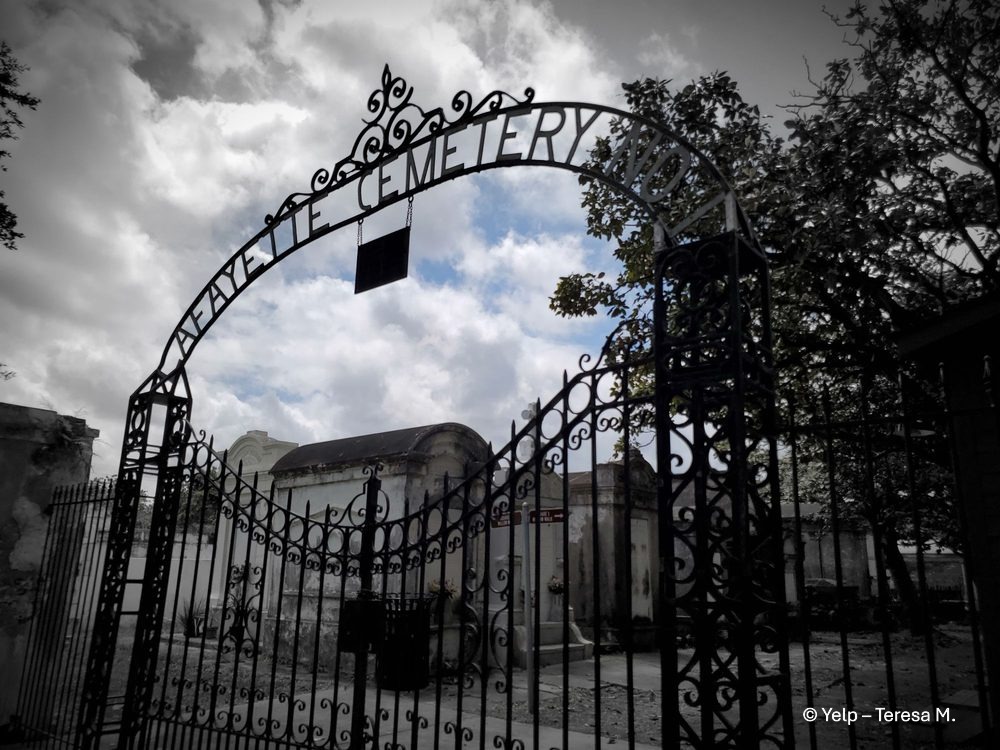 National Register of Historic Places.
Lemann, an emeritus dean of journalism at Columbia University and a Crescent City native, suggests that old cemeteries like Lafayette No. 1 should sit high on his city’s list of required excursions. “New Orleans takes death seriously,” he writes, with its historic burying places full of graves that are “elaborate because family, memory, and melancholy are so important” and built “aboveground because, as legend has it, the water table is so high.”
The article was published nearly four decades ago, but judging by the cycling group I’d been keeping pace with, along with a number of other people outside the cemetery gate, Lemann’s suggestion still holds.
For Lafcadio Hearn, back in his day, the city’s subtropical wetness seemed to take on a different meaning, one at least as figurative as it was literal. “The dampness of New Orleans upon a wet day impresses one as something phenomenal,” he shared with his readers in “New Orleans in Wet Weather,” an 1877 essay included in S. Frederick Starr’s book. “It is spectral, mysterious, inexplicable. Strong walls and stout doors cannot keep it from entering; windows and doors cannot exclude it.”
Flashing forward to early 2024, the tourists and passersby I stood around with outside the shut cemetery gate were excluded by the city’s Division of Cemeteries, whose website I’d navigated to on my phone informed me that “Lafayette Cemetery No. 1 is currently CLOSED TO THE PUBLIC while repairs and improvements take place.”
I wonder what Hearn would’ve had to say about it. In his essay, the “phenomenal” and “spectral” aspects of New Orleans’ wet, humid climate must have led him to throw up his hands and offer a spooky dose of fatalism: “You might as well try to lock out a ghost.” Or lock one in, I suppose.
Nicholas Lemann’s description of his favorite New Orleans cemetery adds some informed depth to my own impression on that January day, looking through its gate, that the place was old and creepy and would have been super-tempting to explore. But, like a bibulous lunch stop at Commander’s Palace, it also wouldn’t be happening that day. Domilise’s po’ boy still awaited me.
[End of Part Two. Part Three—on po’boys, turtle soup, and a Vieux 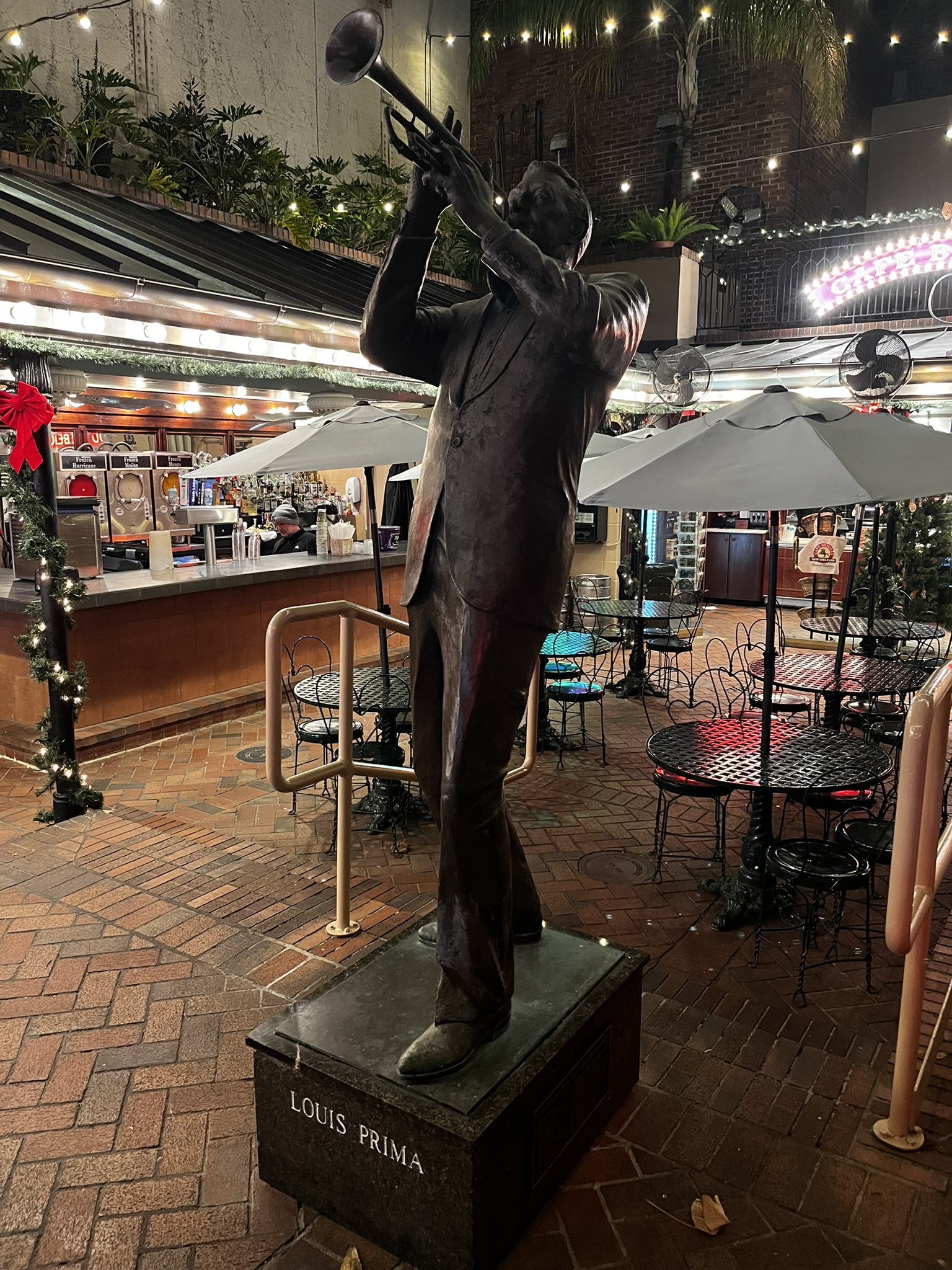 Carré in the Vieux Carré—coming soon.]